
The issue of ocean pollution, and more specifically the long-residence time of plastics, is a pressing issue facing today’s society. My attention was bought to the ‘Great Pacific Garbage Patch’ (GPGP) which is situated between California and Hawaii and I was interested to learn that remote sensing had played a pivotal role in mapping and identifying the material through RGB and hyperspectral shortwave infrared sensing (Garaba et al., 2018). Remote sensing images were used to generate benchmark data on the spatial and temporal variability of the plastics in this area alongside field samples. A paper authored by Lebreton et al (2018) showed that through aerial analysis, the GPGP is estimated to be 1.6 million km², 4-16x higher than initially thought through remote sensing being able to quantify large plastics. The GPGP was quantified through remote sensing so its true scope and subsequent impacts could be researched further. As a visual learner, my first action was to have an accessible overview of the situation and why remote sensing technology was necessary is provided here.
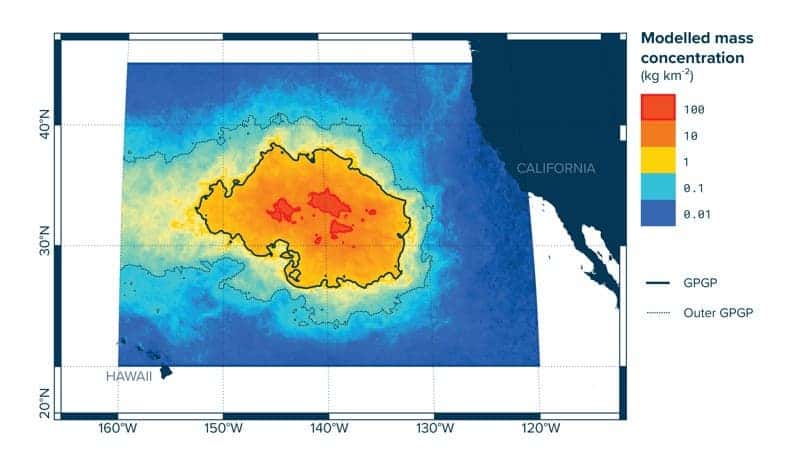
Garaba et al. (2018) used the visible (RGB) imaging to detect large pieces of debris which were then subsequently analysed for their SWIR spectra. SWIR was used in this reconnaissance mission due to environmental difficulties including sun-glints and wind. The team used a hyperspectral short-wave infrared Airborne Spectrographic Imager, meaning the researchers could assess the material using its spectral signature, something covered in the early portion of the course. The spectral signature could then be differentiated from other debris, thus demonstrating the inherent benefits and usefulness of SWIR in sensing ocean plastics with efforts from the researchers to push this method (Lebreton, 2018). Through Garaba et al.’s (2018) paper, I was pleased to see many strands of our coursework being used in a new light. For example, I was delighted to see the same programme we used in class being used by the researchers of ENVI. Equally, it was interesting to see how the researchers did not apply any atmospheric correction to the data in order to reduce errors and that plastic interaction with the electromagnetic spectrum is found in such narrow spectral bands that atmospheric absorption is limited (Garaba et al., 2018).

 Remote Sensing Blog - 10153297